
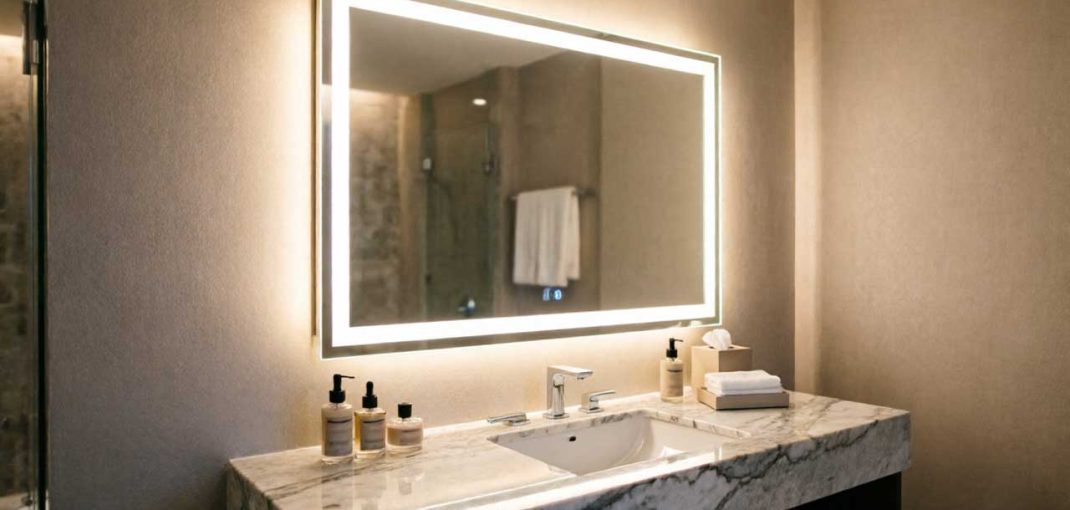
Warum lassen manche LED-Spiegel Hotelgäste verwaschen, müde oder leicht gespenstisch aussehen, während andere ein makelloses, luxuriöses Spiegelbild bieten, in dem sie sich wie Filmstars fühlen?
Die Antwort ist nicht das Glas. Es ist ein versteckter elektrischer Messwert namens CRI, oder Color Rendering Index.
Wenn Sie derzeit für ein kommerzielles Gastgewerbeprojekt auf der Suche nach einem zuverlässigen Partner sind Großhandel Eitelkeitsspiegel Hersteller, Wenn Sie diese einzige Kennzahl verstehen, schützt das Ihren Ruf als Marke. Es bewahrt Sie vor kostspieligen Nachinstallationen. Schauen wir über den Tellerrand der Badezimmerbeleuchtung hinaus, um herauszufinden, was die visuelle Qualität tatsächlich ausmacht.
Inhaltsübersicht
Mehr als die Grundlagen: Was ist CRI bei LED-Spiegeln?
Der Farbwiedergabeindex misst, wie genau eine Lichtquelle die wahren Farben von Objekten im Vergleich zum natürlichen Sonnenlicht wiedergibt. Das Sonnenlicht steht mit einem perfekten CRI von 100 an der Spitze des Berges.
Jahrzehntelang galt in der gewerblichen Beleuchtungsindustrie CRI 80 als Basiswert für Innenräume. Für Flure war das in Ordnung. Es funktionierte für Treppenhäuser. Aber wenn es um den Waschtisch im Badezimmer geht - wo sich die Gäste rasieren, schminken und ihre Haut untersuchen - versagt CRI 80 einfach. Er verzerrt die Töne.
Beim Kauf von Standard Großhandel Eitelkeitsspiegel Mit billigen LED-Streifen erhalten Sie einen niedrigen CRI. Dem Licht fehlt der spektrale Reichtum, der erforderlich ist, um tiefe, akkurate Farbtöne zu reflektieren. Das lässt die Menschen erschöpft aussehen. Im Gegensatz dazu verwenden hochwertige LED-Spiegel Streifen mit CRI 90+. Der Unterschied ist sofort erkennbar. Ein höherer CRI bedeutet, dass die Lichtquelle ein volleres, kontinuierlicheres Lichtspektrum ausstrahlt, das die Farblücken füllt, die LEDs von geringerer Qualität auslassen.
Die versteckte Metrik, die Käufer vermissen: Ra vs. R9
Hier ein Branchengeheimnis, das Ihnen die meisten Anbieter nicht verraten werden: Der Standard-CRI liegt im Durchschnitt bei nur acht Pastellfarben. Dies ist bekannt als Ra. Ein Hersteller kann damit prahlen, dass er eine Ra von 90, aber ihr Spiegel kann immer noch schrecklich aussehen, wenn man davor steht.
Warum? Weil sie bei der R9 Test.
Die R9 Wert misst gesättigtes Rot. Denken Sie an die menschliche Anatomie. Unsere Hauttöne, ob hell oder dunkel, sind stark auf rote und rosa Untertöne angewiesen, um gesund und lebendig auszusehen. Wenn ein LED-Streifen einen hohen Ra sondern ein erbärmlicher R9 Der Spiegel entzieht dem Teint des Gastes die Wärme vollständig. Das Auftragen von Make-up wird zur Katastrophe, weil die Farben völlig anders aussehen, sobald der Gast nach draußen ins Tageslicht tritt.
Für das gehobene Gastgewerbe, hochwertige Mehrfamilienhäuser und Luxussalons raten wir den Käufern immer, einen doppelten Standard zu verlangen: CRI ≥ 90 UND R9 ≥ 50.
[Volles Lichtspektrum] -> Enthält R1 bis R8 (Pastellfarben für Standard-Ra)
                      -> Enthält vor allem R9 (gesättigtes Rot für Hauttöne)
| Attribut Beleuchtung | Low-End/Standard-Spiegel | Premium-Großhandel Eitelkeitsspiegel |
|---|---|---|
| Durchschnittlicher CRI (Ra) | 70 bis 80 | 90+ |
| Gesättigtes Rot (R9) | Oft unter 0 (nicht gemessen) | 50 bis 80+ |
| Farbtreue (Rf) | < 75 | ≥ 88 |
| Farbgamut (Rg) | < 90 | 95 - 105 (perfekte Sättigung) |
| Visueller Effekt | Stumpfe, gräuliche Hauttöne | Lebendige, natürliche und gesunde Reflexe |
| Am besten geeignet für | Öffentliche Korridore, günstige Motels | Luxushotels, Spas, gehobener Einzelhandel |

Was wir auf dem Feld gelernt haben: Ein Weckruf für die Gastfreundschaft
Vor einigen Jahren arbeiteten wir mit einer Boutique-Hotelmarke in Miami zusammen, die 120 Gäste-Suiten modernisieren wollte. Sie umgingen zunächst unsere Ratschläge und bestellten preisgünstige hinterleuchtete Spiegel bei einem allgemeinen Handelsunternehmen. Auf dem Papier sahen die Spezifikationen akzeptabel aus.
Drei Wochen nach der Eröffnung trudelten die ersten negativen Bewertungen auf TripAdvisor ein. Die Gäste beschwerten sich über die “verhörraumkalte” Badezimmerbeleuchtung. Bräute, die im Resort übernachteten, bemerkten, dass ihr Make-up orangefarben aussah, sobald sie auf die sonnenüberfluteten Balkone hinausgingen.
Die Hotelleitung rief uns in Panik an. Wir brachten unser tragbares Ulbricht-Kugelspektrometer direkt in die Gästetoiletten, um eine Live-Diagnose durchzuführen. Die Ergebnisse waren aufschlussreich. Die Spiegel gaben zwar einen CRI-Wert von 85 an, ihr tatsächlicher R9-Wert lag jedoch bei schockierenden -12. Sie waren völlig frei von Licht aus dem roten Spektrum.
Schließlich rüsteten wir alle 120 Suiten mit unseren maßgeschneiderten CRI 90+ LED-Spiegelmodule. Die Veränderung trat sofort ein. Die Gäste beschwerten sich nicht mehr, und das Hotel verzeichnete sogar einen Anstieg der Check-ins in den sozialen Medien, weil die Kosmetikspiegel endlich eine schöne, Selfie-freundliche Beleuchtung boten. Dieses Projekt hat uns in unserer Überzeugung bestärkt, dass man es sich nicht leisten kann, bei der spektralen Qualität der Waschtischbeleuchtung zu sparen.
Kommerzieller ROI: Warum sich Investitionen in hohe CRI-Werte auszahlen
Der Kauf von Spiegeln mit niedrigem CRI ist ein klassisches Beispiel dafür, dass man Centbeträge spart, um Dollarbeträge zu verlieren. LED-Streifen mit hohem CRI erfordern eine bessere Phosphorchemie und hochwertige LED-Chips, wie sie von Epistar oder Samsung hergestellt werden. Das macht den Anschaffungspreis etwas höher. Die Rentabilität der Investition ist jedoch unbestreitbar.
Denken Sie zunächst an die Farbstabilität im Laufe der Zeit. Günstigere LED-Streifen verschlechtern sich schnell. Ihre Farbe verändert sich innerhalb eines Jahres bei Dauerbetrieb in Richtung eines hässlichen grünlichen oder violetten Farbtons. Unsere hochwertigen Großhandelsspiegel verwenden eng gebündelte LEDs, die innerhalb einer 3-stufigen MacAdam-Ellipse gesteuert werden. Dies garantiert, dass jeder einzelne Spiegel in Ihrem Hotelkorridor Jahr für Jahr die exakt gleiche Farbtemperatur und scharfe Wiedergabe aufweist.
Zweitens sollten Sie den Erlebnisfaktor berücksichtigen. Hochwertige Spas, Friseursalons und Luxusboutiquen verlassen sich auf visuelle Präzision, um ihre Dienstleistungen zu verkaufen. Wenn ein Kunde in einem Friseursalon seine Haare färbt und in einen Spiegel mit niedrigem Farbwiedergabeindex schaut, wird er das Ergebnis hassen. Wenn Sie eine akkurate, naturgetreue Umgebung bieten, steigern Sie direkt die Wahrnehmung des Kunden von Ihrer Dienstleistungsqualität.

Leitfaden zur Lieferanteninspektion: Wie man gefälschte CRI-Angaben erkennt
Die globale Produktionslandschaft ist hart umkämpft, und leider ist Papier geduldig. Viele Vertreter von Fabriken kleben gerne einen “CRI 90”-Aufkleber auf eine Schachtel mit einem billigen CRI 75-Streifen. Sie brauchen einen kugelsicheren Überprüfungsprozess, um diese schlechten Akteure zu vermeiden.
Bei der Analyse der potenziellen Großhandel Eitelkeit Spiegel Lieferanten, Wir empfehlen, sie genau diesem dreistufigen Screening-Protokoll zu unterziehen:
-
- Fordern Sie den IES-Bericht TM-30-15 an: Geben Sie sich nicht mit einem CIE-CRI-Bericht alter Schule zufrieden. Fragen Sie nach dem umfassenden TM-30-15-Datenblatt. Dieser neuere Industriestandard verwendet 99 Farbbewertungsmuster anstelle von nur 8, so dass Sie ein kristallklares Bild von Farbtreue (Rf) und Farbumfang (Rg) erhalten. Wenn ein Lieferant zögert oder nicht weiß, was ein TM-30-Bericht ist, sollten Sie die Finger davon lassen.
- Fordern Sie einen Testbericht für eine Ulbricht-Kugel an: Jede seriöse LED-Spiegelfabrik sollte über ein eigenes Prüflabor verfügen, das mit einem Spektralradiometer und einer Ulbricht-Kugel ausgestattet ist. Fordern Sie die rohen, unbearbeiteten PDF-Testdaten für die genaue Charge von LED-Streifen an, die für Ihre Bestellung vorgesehen ist.
- Überprüfen Sie die Einhaltung von Vorschriften und Zertifizierungen: Vergewissern Sie sich, dass die gesamte Spiegelbaugruppe - nicht nur der interne Treiber - gültige regionale Zertifizierungen wie UL, ETL oder CE trägt. Damit wird bestätigt, dass das Produkt die wesentlichen Sicherheits- und Leistungsanforderungen erfüllt.
Wie wir in jeden Spiegel Exzellenz einbauen
In unseren eigenen Produktionsstätten behandeln wir die Lichtqualität wie eine absolute Wissenschaft. Wir beziehen keine vorkonfektionierten LED-Streifen von Drittanbietern aus dem Großhandel. Stattdessen kontrollieren wir den technischen Prozess von Grund auf.
Jedes Los von Bauteilen wird einer strengen Qualitätskontrolle unterzogen. Wir unterziehen alle unsere Light Engines einem obligatorischen 48-stündigen Einbrenn- und Alterungstest. Wir prüfen sie mit speziellen Spektrometern, um sicherzustellen, dass unsere Ra bleibt deutlich über 92 und unser R9 sinkt nie unter 60. Durch die Beherrschung dieser technischen Variablen können wir mit Zuversicht Großhandelsspiegel in kommerzieller Qualität liefern, die den anspruchsvollen Umgebungen in modernen Gaststätten gerecht werden.

Leute fragen auch: Häufig gestellte Fragen
Ist ein höherer CRI-Wert bei Badezimmerspiegeln immer besser?
Ja, für Waschräume ist ein höherer CRI-Wert immer besser. Ein Wert von 90 oder höher stellt sicher, dass menschliche Hauttöne, Kosmetika und Haarfarben genau erkannt werden, was für die Körperpflege unerlässlich ist.
Ja, für Waschräume ist ein höherer CRI-Wert immer besser. Ein Wert von 90 oder höher stellt sicher, dass menschliche Hauttöne, Kosmetika und Haarfarben genau erkannt werden, was für die Körperpflege unerlässlich ist.
Was ist der Unterschied zwischen CRI 80 und CRI 90 bei LED-Spiegeln?
Eine Lichtquelle mit einem CRI-Wert von 80 lässt kritische Teile des Farbspektrums aus, wodurch leuchtende Farben matt oder grau erscheinen. Ein Spiegel mit 90 CRI bietet eine vollständige Spektralabdeckung, die Farben lebendig und gesunde Hauttöne genau wiedergibt.
Eine Lichtquelle mit einem CRI-Wert von 80 lässt kritische Teile des Farbspektrums aus, wodurch leuchtende Farben matt oder grau erscheinen. Ein Spiegel mit 90 CRI bietet eine vollständige Spektralabdeckung, die Farben lebendig und gesunde Hauttöne genau wiedergibt.
Woher weiß ich, ob ein Anbieter von LED-Spiegeln tatsächlich einen CRI 90 liefert?
Bitten Sie den Hersteller stets um einen offiziellen Prüfbericht für die Integrierende Kugel und einen TM-30-15-Farbbericht für das jeweilige Produktionslos. Seriöse Lieferanten werden diese zertifizierten Dokumente problemlos zur Verfügung stellen.
Bitten Sie den Hersteller stets um einen offiziellen Prüfbericht für die Integrierende Kugel und einen TM-30-15-Farbbericht für das jeweilige Produktionslos. Seriöse Lieferanten werden diese zertifizierten Dokumente problemlos zur Verfügung stellen.
Bedeutet ein hoher CRI-Wert, dass der Spiegel heller ist?
Nein. CRI misst die Farbgenauigkeit, nicht die Helligkeit. Die Gesamthelligkeit wird in Lumen gemessen. Es ist durchaus möglich, einen hocheffizienten, unglaublich hellen Spiegel zu haben, der trotzdem einen schlechten CRI-Wert aufweist. Prüfen Sie immer beide Messwerte unabhängig voneinander.
Nein. CRI misst die Farbgenauigkeit, nicht die Helligkeit. Die Gesamthelligkeit wird in Lumen gemessen. Es ist durchaus möglich, einen hocheffizienten, unglaublich hellen Spiegel zu haben, der trotzdem einen schlechten CRI-Wert aufweist. Prüfen Sie immer beide Messwerte unabhängig voneinander.
Referenzen und Industrienormen
- IES LM-79-19: Das anerkannte Verfahren für optische und elektrische Messungen von Festkörperbeleuchtungsprodukten, das absolute Genauigkeit bei Lumen- und CRI-Daten gewährleistet. Erfahren Sie mehr über die Webshop der Illuminating Engineering Society (IES) [1].
- WELL Building Standard (v2) - Lichtkonzept: Globale Gebäuderichtlinien, die eine hohe Farbwiedergabe (R9) vorschreiben, um die menschliche Gesundheit und Sehschärfe in hochwertigen Innenräumen zu unterstützen. Das vollständige Rahmenwerk finden Sie auf der Digitale Plattform des Internationalen Instituts für WELL-Gebäude (IWBI) [2].
- CIE 224:2017: Der offizielle Standard für den Farbtreueindex (Rf), der den globalen Rahmen für die Bewertung der Farbechtheit unter LED-Lichtmaschinen bildet. Zugriff auf die Veröffentlichung über die Webshop der Internationalen Beleuchtungskommission (CIE) [3].
- Titel 24, Teil 6 (Gemeinsamer Anhang JA8): Die strenge kalifornische Norm für Gebäudeeffizienz schreibt Lichtquellen mit hohem Farbwiedergabewert (CRI 90, R9) für Sanitärräume vor. Lesen Sie die gesetzlichen Vorgaben direkt auf der Offizielles Portal der kalifornischen Energiekommission [4].
ÜBER DEN AUTOR
Frank Chan ist Senior Product Consultant & Sales Manager bei Dimo und verfügt über mehr als 10 Jahre Erfahrung im Bereich der High-End-LED-Beleuchtung. Er hat die Einhaltung der Vorschriften und die Installation von über 200 Projekten in ganz Nordamerika beaufsichtigt. Frank Chan unterstützt B2B-Kunden bei der Einhaltung komplexer elektrischer Vorschriften, um einen langfristigen Projekterfolg zu gewährleisten.
Frank Chan ist Senior Product Consultant & Sales Manager bei Dimo und verfügt über mehr als 10 Jahre Erfahrung im Bereich der High-End-LED-Beleuchtung. Er hat die Einhaltung der Vorschriften und die Installation von über 200 Projekten in ganz Nordamerika beaufsichtigt. Frank Chan unterstützt B2B-Kunden bei der Einhaltung komplexer elektrischer Vorschriften, um einen langfristigen Projekterfolg zu gewährleisten.




1 Kommentare
Great article! Keep updating!