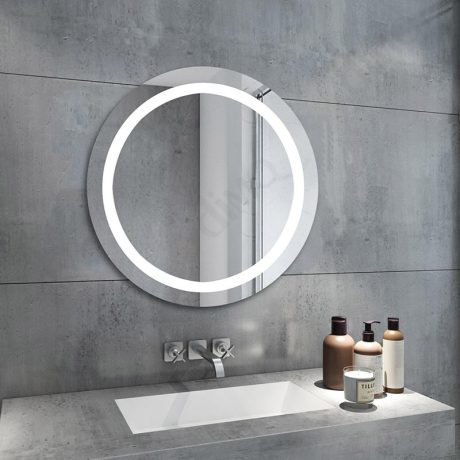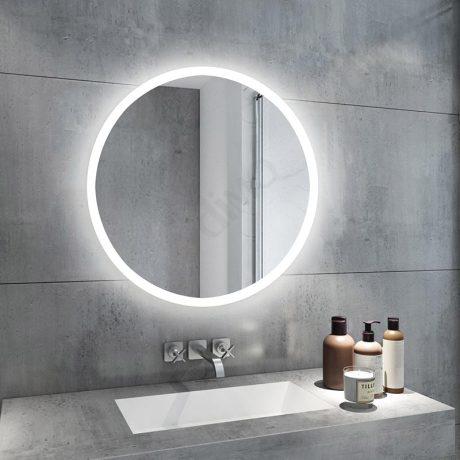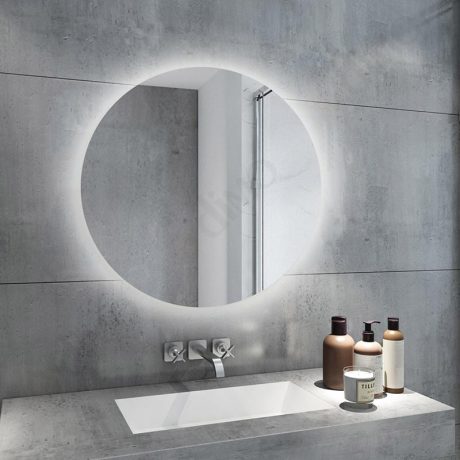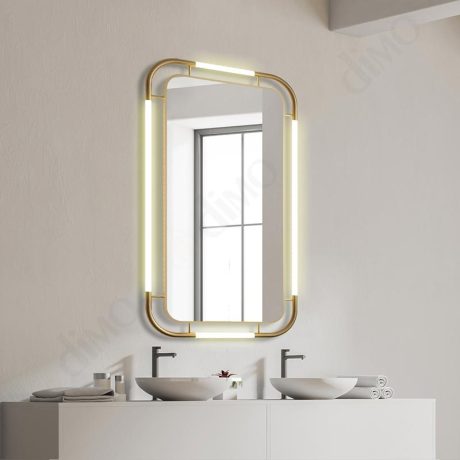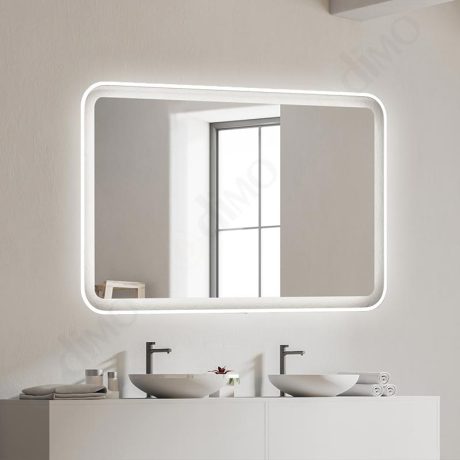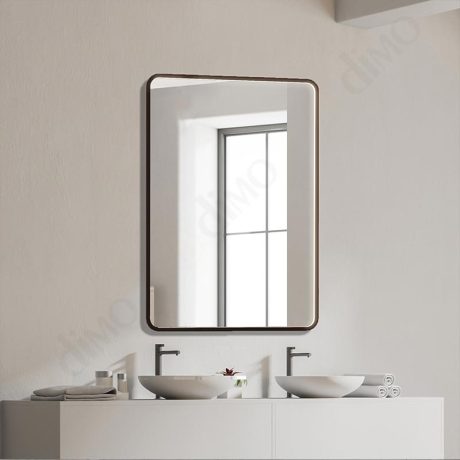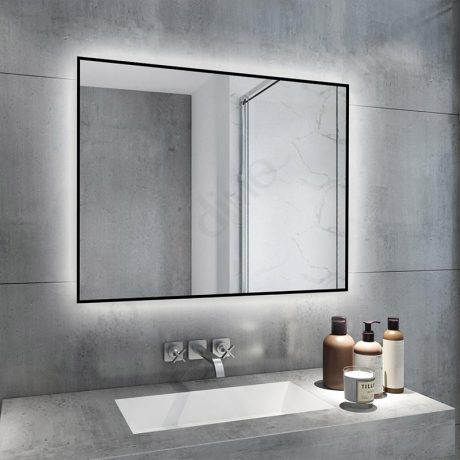
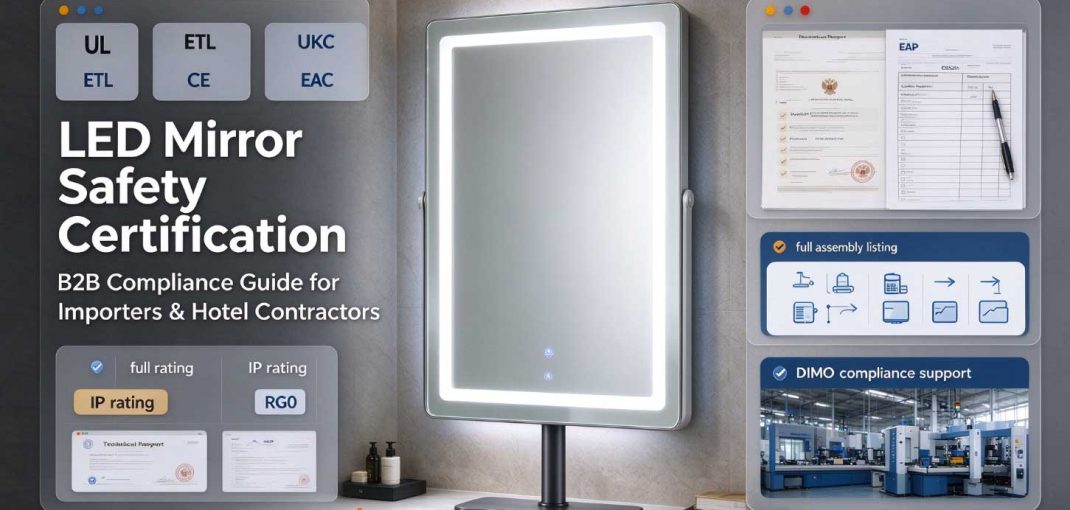
I’ve been in LED mirror sourcing long enough to watch the same scenario play out over and over. A buyer lands a great deal on a mirror, ships a container, and then gets hit with a customs hold, a rejected hotel inspection, or a delisted listing that kills months of sales. The cause is almost never the product quality. It’s the certification. So let me walk you through what actually matters when you’re buying or selling LED mirrors at scale — not the surface-level “just get UL and CE” advice you’ll find everywhere, but the full-assembly compliance logic that keeps your shipment and your project moving.
Inhaltsübersicht
The Real Cost of Getting Certification Wrong
Before we dig into standards, understand who this guide is for. If you’re a home user buying one vanity mirror, almost any certified product will do. But if you’re a hotel procurement manager, a general contractor, a customs broker, or a wholesaler bringing in pallets for Wildberries, Ozon, Amazon, or a brick-and-mortar chain, the stakes change completely.
Here’s what’s actually on the line:
- Customs seizures. A container held at port costs you demurrage, legal fees, and weeks of delay. In some markets, it never gets released.
- Project rejection. Electrical inspectors on commercial jobs are ruthless. If your mirror isn’t listed as a complete unit, the whole bathroom project fails sign-off.
- Insurance claims. If a certified-only-driver mirror causes a fire, insurers look at the full unit. Component certification won’t protect you.
- Platform delisting. Marketplaces now audit certificates against their registries. One mismatch and your listing disappears, sometimes permanently.
None of this is hypothetical. We’ve watched clients absorb every single one of these hits.
Core Safety Certifications by Target Market
Every market has its own regime, and treating them as interchangeable is the fastest way to lose money. Here’s the breakdown we use internally, plus the trap each one hides.
North America: UL and ETL, and the Distinction That Saves Your Project
In the US and Canada, the two names you’ll see are UL und ETL. Both are Nationally Recognized Testing Laboratories (NRTL), and both are accepted by electrical authorities. There’s also cETLus und cULus for combined US–Canada coverage.
But here’s the part most articles skip, and it’s the single biggest trap in this whole industry. A certified LED driver does not make the mirror certified. In North America there’s a hard line between component recognition (the driver alone is UL recognized) and full assembly listing (the complete mirror — glass, frame, touch switch, LED strip, driver, wiring — is UL Listed as one unit). Commercial inspectors, insurers, and customs only accept the full-assembly listing for hospitality and multi-family projects.
Relevant standards: UL 962 (household and commercial furnishings), UL 1598 (luminaire), UL 8750 (LED equipment). If your supplier hands you a driver certificate and calls it done, run.


EU: CE Is Not a Third-Party Certificate
This one confuses a lot of importers. CE is not issued by a testing lab. It’s a manufacturer’s self-declaration (Declaration of Conformity, or DOC) backed by test reports covering the Low Voltage Directive (LVD), EMC, RoHS, and increasingly REACH. Your supplier has to hold the full technical file, not just the mark. Miss a document and EU customs can detain your shipment.
UK: UKCA After Brexit
Since Brexit, UKCA has replaced CE for most goods sold in Great Britain, and you can’t just reuse your CE documentation. For bulk imports you’ll likely need to mark both CE and UKCA, each with its own technical file. It’s a separate cost line buyers routinely forget to budget.

Russia and the EAEU: EAC, and the DoC vs Certificate Trap
Russia, Belarus, Kazakhstan, Armenia, and Kyrgyzstan operate under the Eurasian Economic Union regime, and the mark is EAC. Two things catch LED mirror importers here more than anything else.
First, powered LED illuminated mirrors fall under TR CU 004/2011 (low voltage), TR CU 020/2011 (EMC), and TR EAEU 037/2016 (EAEU RoHS). That means they need an EAC Certificate — issued by an accredited body with sample testing and, for serial production, factory audit — not just an EAC Declaration of Conformity (DoC), which is a self-declaration. We’ve seen suppliers quote a cheap DoC, and then the shipment sits in Russian customs. Only a non-powered mirror can slide by with a DoC.
Second, EAEU rules require a local authorized representative in the customs union. You can’t declare compliance from an overseas factory. You also need a Russian technical passport and a Russian-language user manual, plus product labeling with the EAC mark, the representative’s details, and the model number. Wildberries and Ozon both check that your EAC certificate is traceable in the EAEU registry and that the model matches your listing exactly.

Australia, New Zealand, Middle East
Down under it’s SAA plus the RCM declaration. In the Middle East you’re looking at ESMA (UAE) and SASO (Saudi), which usually require product registration on national portals. Each one is a separate project, not a checkbox.
| Market | Main Mark | Core Documents | The Trap Most Buyers Fall Into |
|---|---|---|---|
| USA / Canada | UL / ETL / cETLus / cULus | Full-assembly NRTL listing, test report | Driver component cert ≠ whole mirror listed |
| European Union | CE | DOC + LVD/EMC/RoHS/REACH test reports | CE is self-declaration, not third-party cert |
| Vereinigtes Königreich | UKCA | UKCA DOC + supporting reports | CE alone no longer valid in GB after Brexit |
| Russia / EAEU | EAC | EAC Certificate + Russian tech passport + manual + local rep | DoC is not enough for powered mirrors; no overseas self-declaration |
| Australia / NZ | SAA / RCM | SAA cert + RCM declaration | Wet-zone IP rating gets overlooked |
| UAE / Saudi | ESMA / SASO | National portal registration + test reports | Portal registration is mandatory, not optional |
Beyond Electrical Certification: Four Things Everyone Forgets
Electrical safety gets all the attention, but these four are where real projects fail.
IP rating. For LED bathroom mirrors, the wet-zone boundary matters. IP44 protects against splashing and works outside the immediate shower area; IP54 adds dust resistance; IP65 handles jets and is what you want in fully wet zones. Match the rating to where the mirror will actually hang, and put it on the label.
Copper-free silver mirror and explosion-proof film. In humid bathrooms, a standard silver-backed mirror can degrade and, in the worst cases, the backing can corrode and the mirror can crack. Copper-free mirrors resist this. For hospitality and high-traffic areas, explosion-proof film keeps shattered glass from becoming a liability claim. This is an easy, cheap upgrade that separates a professional supplier from a commodity one.
Photobiological safety, RG0. This is the one almost nobody talks about. The IEC 62471 standard classifies the blue-light and optical radiation risk of LEDs. For mirrors used in salons, hotels, and commercial settings where people stand close for long periods, you want RG0 (exempt) rather than RG1 or RG2. It’s an engineering decision your supplier should be able to document.
EMC and EMI. A hotel bathroom is packed with electronics. If your mirror’s driver pumps out electromagnetic interference, it can disrupt smart systems, networked controls, or even the bathroom’s own sensors. EMC testing under the relevant standard (EN 55015, FCC Part 15 in the US) keeps your product from becoming “that mirror that causes problems.”


How to Verify a Certificate Is Actually Worth the Paper It’s Printed On
Anyone can send you a JPG of a certificate. Here’s how we validate them, and you should too.
Match the model number and manufacturer name on the certificate against the rating label on the product. A certificate that says “LED mirror model X” covering a mirror labeled “model Y” is worthless. This mismatch is shockingly common, especially on marketplaces.
Look it up in the official registry. For UL, use UL Product iQ. For ETL, the Intertek directory. For EAC, check the EAEU unified register. If you can’t find it, it doesn’t exist, no matter how official the PDF looks.
Read the test report, not just the cover page. The cover shows the pretty logo. The report shows what was actually tested — including whether the tested item was the full mirror assembly or just a component.
Check the validity window and the scope. EAC certificates come in different schemes: single-batch versus serial production, and serial production requires annual surveillance audits. An expired or out-of-scope certificate is a liability wearing a logo.
Watch for red flags. Certificates from bodies you can’t verify, missing local authorized representative info on EAEU documents, or a supplier who can’t explain the difference between component and full-assembly coverage — these are all reasons to walk away.

What We’ve Learned at DIMO: A Real Project
I’ll give you a concrete example from our own floor, because this is exactly why we built our process the way we did. Last year a Russian importer — a large account with a serious Wildberries presence — came to us with a million-unit-scale OEM request. They’d been burned before: a previous supplier handed them an EAC DoC for a powered mirror, the container hit Russian customs, and the whole order got stuck. They came to us angry and skeptical.
So we did what we always do. We started from the full-assembly requirement, not from the price sheet. Our engineering team rebuilt the mirror to carry a genuine EAC Certificate for the complete unit — glass, frame, touch control, LED strip, driver, all under one certificate. We supplied the Russian technical passport, the Russian-language manual, the compliant labeling with the EAC mark and the authorized representative’s details. Then we walked them through the Wildberries listing requirements so the model numbers matched down to the digit. The shipment cleared customs without a hitch. That account is still with us, because we treated compliance as the foundation of the deal, not an afterthought.
That’s the difference between a supplier and a partner. We’ve done the same for North American buyers chasing ETL/cETLus full-assembly listing and for EU clients assembling complete CE technical files. The lesson is always identical: nail the certification early, or pay for it later.
Common Compliance Failures: Real Scenarios
Let’s make the risk concrete with three scenarios we’ve seen or heard from industry peers.
Case 1 — Driver listed, mirror not. A hotel contractor bought mirrors where only the driver carried UL recognition. The electrical inspector on a large multi-family project rejected the entire bathroom installation because the mirrors weren’t listed as complete assemblies. Every unit had to be replaced, and the contractor ate the labor.
Case 2 — CE without the full file. An EU importer shipped mirrors marked CE but couldn’t produce the complete DOC and supporting LVD/EMC/RoHS reports. Customs detained the consignment until the paperwork materialized, costing weeks and significant storage fees.
Case 3 — Glass coating fails REACH. A mirror passed basic electrical checks but its surface coating didn’t comply with REACH restrictions. On a platform with strict chemical compliance checks, the listing was removed and the seller’s account flagged.
None of these are exotic. They’re the routine cost of treating certification as paperwork instead of engineering.
The B2B Sourcing Checklist (Steal This for Your PO)
Here’s what should be in your purchase order language, market by market. Copy the clauses and you’ll save yourself a world of pain.
Pre-order audit:
- Supplier provides full-assembly certificate (not component-only), verified in the relevant registry.
- Certificate model number matches your order’s model number exactly.
- For EAEU: EAC Certificate for the complete mirror, Russian technical passport, Russian manual, and an authorized representative with a registered tax ID.
- Complete test reports, not just certificate cover pages.
- Photobiological safety class (RG0 target) and IP rating stated in writing.
Pre-shipment inspection:
- Rating label carries the correct mark, model, electrical parameters, and (for EAEU) the authorized representative’s details.
- Marking is permanently applied, not a peelable sticker, where regulation requires it.
- Full document package ships with the goods: certificates, test protocols, technical passport, manual, DOC where applicable.
Required document package:
- Full-assembly NRTL listing (US/CA), EAC Certificate (EAEU), CE DOC + test reports (EU), UKCA file (UK).
- Material declarations for RoHS/REACH.
- Test reports for IP, IEC 62471, and EMC.

Häufig gestellte Fragen
These are the questions buyers actually type into Google, and the answers we give clients every week.
Q: If the LED driver has UL, does that make the whole LED mirror UL Listed? A: No. Driver certification is component recognition. For commercial projects, customs, and insurance in North America, you need the complete mirror assembly to carry a full UL or ETL listing. A certified driver alone won’t pass an electrical inspection.
Q: What certification do I need to sell LED mirrors on Wildberries or Ozon? A: Powered LED illuminated mirrors need an EAC Certificate for the full assembly, not just an EAC Declaration of Conformity. You also need a Russian technical passport, Russian-language manual, and a locally registered authorized representative.
Q: Can a CE-certified LED mirror be sold in the US? A: No. CE is a European self-declaration and isn’t accepted for US commercial projects or customs clearance. US authorities require an NRTL listing such as UL or ETL for the complete assembly.
Q: Is IP44 enough for a LED mirror above a sink? A: Usually yes for a vanity area with no direct water jets. But in a shower zone or a wet commercial bathroom, step up to IP54 or IP65. Always match the rating to the actual installation zone and state it on the label.
Q: What documents must a supplier provide for UKCA import? A: A UKCA Declaration of Conformity plus the supporting technical file covering low voltage, EMC, RoHS, and REACH. Since Brexit, CE documentation on its own is no longer valid for Great Britain.
How We Support B2B Buyers on Safety Certification
At DIMO, compliance is how we’ve built long-term relationships in Russia, Europe, and North America. We provide full-assembly NRTL and EAC certification, complete document packages for customs, tenders, and platform submissions, and pre-compliance reviews for custom sizes and private-label models before you commit to a container. If you’re bringing in a new mirror design or entering a new market, that’s exactly where we earn our keep.
Referenzen
- UL Product iQ — verify UL listings: https://iq.ulprospector.com/
- Intertek ETL directory — verify ETL listings: https://www.intertek.com/directories/etl/
- UL 962 — Standard for Household and Commercial Furnishings
- UL 1598 — Standard for Luminaires
- UL 8750 — Standard for Light Emitting Diode (LED) Equipment
- IEC 62471 — Photobiological safety of lamps and lamp systems
- TR CU 004/2011 — EAEU Low Voltage safety: https://eec.eaeunion.org/
- TR CU 020/2011 — EAEU Electromagnetic compatibility
- TR EAEU 037/2016 — EAEU RoHS
- UKCA guidance — UK Government: https://www.gov.uk/guidance/using-the-ukca-marking
Frank Chan ist Senior Product Consultant & Sales Manager bei Dimo und verfügt über mehr als 10 Jahre Erfahrung im Bereich der High-End-LED-Beleuchtung. Er hat die Einhaltung der Vorschriften und die Installation von über 200 Projekten in ganz Nordamerika beaufsichtigt. Frank Chan unterstützt B2B-Kunden bei der Einhaltung komplexer elektrischer Vorschriften, um einen langfristigen Projekterfolg zu gewährleisten.