Table of Contents
1. The Silver Price Spike: Is Your Budget Shrinking?
Facing today’s raw material market, are you feeling the squeeze?
Over the past year, global silver prices have undergone a textbook-style explosion. As the core raw material for high-end Copper-Free Silver Mirrors, this volatility has directly pushed factory prices up by 15% to 25%. For hotel contractors, wholesale distributors, and vanity manufacturers, this isn’t just a “cost increase”—it’s a brutal hit to profit margins.
I am often asked a pointed question: “Is there no middle ground between overpriced silver mirrors and traditional aluminum mirrors that develop ‘black freckles’ (edge corrosion) within three years?”
The market has shifted. As an industry veteran at DIMO, I understand the B2B pain: We want the durability of silver, but we need the rational pricing of aluminum. This is exactly why we developed our “New Generation Anti-Corrosion Aluminum Mirror.”

2. Technical Breakdown: Copper-Free Silver vs. Traditional Aluminum
Before discussing the new tech, we must be honest about the native differences between the two.
Copper-Free Silver Mirror
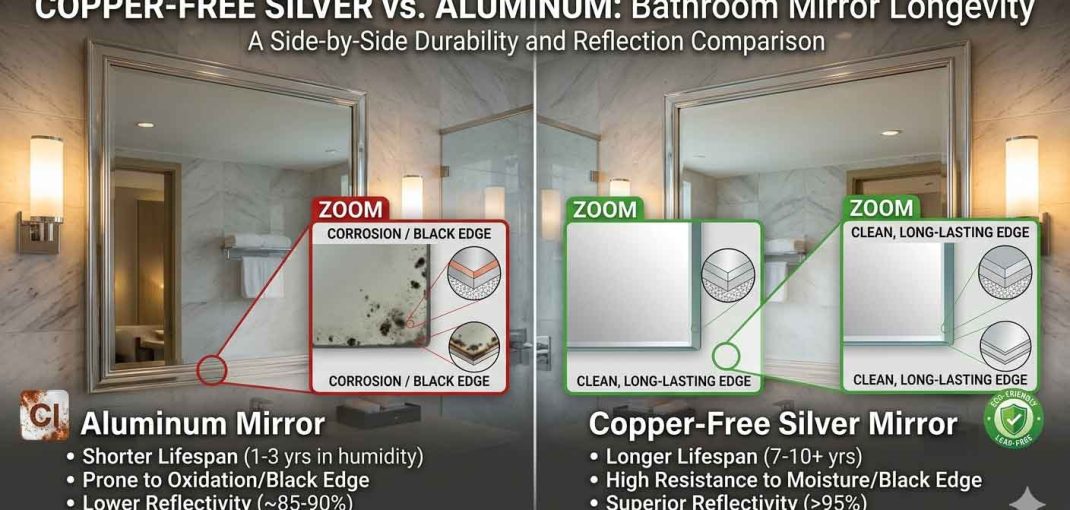
Traditional silver mirrors use a copper film behind the silver layer to enhance adhesion. However, copper reacts easily with moisture. Copper-free mirrors replace this with specialized passivation agents.
-
Pros: Reflectivity over 95%; no green oxidation because there is no copper.
-
LSI Keywords: Eco-friendly mirror, High reflectivity, Passivation process.
Traditional Aluminum Mirror
Created via vacuum sputtering where aluminum atoms are deposited on glass.
-
The Fatal Flaw: Aluminum is much more chemically active than silver. In high-humidity bathrooms, moisture seeps into the edges, causing the aluminum to oxidize and peel rapidly, resulting in ugly black edges.
3. Industry Standards: Why Do Mirrors Turn Black at the Edges?
If you are reviewing competitor spec sheets, you must look for two international standards: ISO 9227 and ASTM B117.
Bathroom environments are filled with chloride ions and water vapor—the natural enemies of glass. According to ISO 9227 salt spray standards, standard aluminum mirrors often show edge corrosion after just 48 hours. High-end copper-free silver mirrors can last over 300 hours.
Why do we obsess over “edge protection”? For B2B orders, a mirror that develops black edges two years after installation doesn’t just mean high warranty costs—it destroys your brand reputation.

4. The Breakthrough: Engineering an Aluminum Mirror with “Silver-Grade” Lifespan
This is where I get excited. Faced with skyrocketing silver prices, we didn’t lower the thickness of our silver mirrors. Instead, we decided to completely reconstruct the protective system of the aluminum mirror.
After 14 failed iterations in our R&D lab, we perfected a unique “Multi-Layer Composite Protection” process.
Our Internal Process (The “How-To”):
-
Ultra-Sonic Cleaning: We use deionized water and specialized polishing powders to ensure the glass surface is free of microscopic contaminants.
-
Nano-Sputtering: In a vacuum chamber, we precisely control the aluminum layer thickness, boosting reflectivity to 91-93% (extremely close to silver).
-
The Core Isolation Layer: This is our secret weapon. After the aluminum layer, we apply a special anti-oxidation passivation film. Its molecular structure is so dense that it effectively blocks chloride ion penetration.
-
Double-Layer Italian FENZI Paint: Finally, we apply two coats of high-performance protective paint infused with anti-fungal agents.
Through this “Triple-Threat” protection, our anti-corrosion aluminum mirror achieves a massive leap in durability.
5. Comparison Table: Performance vs. Cost in 2026
| Feature | Standard Aluminum | Copper-Free Silver | Our Anti-Corrosion Aluminum |
| Reflectivity | 85% – 88% | 95% + | 91% – 93% |
| Corrosion Resistance (CASS) | < 48 Hours | 300+ Hours | 240+ Hours |
| Black Edge Risk | Normal | Very Low | Very Low |
| Cost Index (2026) | ★☆☆☆☆ | ★★★★★ | ★★☆☆☆ |
| Best Application | Dry areas/Temporary | Luxury Hotels | Modern Apartments/LED Mirrors |
Data Source: Internal testing at DIMO

6. B2B Procurement Guide: Selecting the Right Mirror for Your Project
As a procurement manager, you don’t always need to buy the most expensive option.
-
If your project is a 5-Star Hotel: Stick with the Copper-Free Silver Mirror. The depth of the reflection and the absolute precision of the image are critical for luxury spaces.
-
If your project is a Modern Apartment or Large-Scale Housing: Our Anti-Corrosion Aluminum Mirror is the undisputed king of ROI. To the naked eye, the clarity is nearly indistinguishable, yet it saves at least 30% on material costs.
A pro tip from the field: Regardless of what you choose, always demand “Edge Sealing.” It’s like an invisible raincoat for your mirrors.
Frequently Asked Questions (FAQ)
Q1: Is there a noticeable visual difference between aluminum and silver? Under side-lighting, silver mirrors have a deeper, darker base and more “3D” depth. Standard aluminum can look a bit “flat” or white. However, our anti-corrosion version optimizes reflectivity so well that once installed as an LED Bathroom Mirror, non-professionals find it nearly impossible to tell the difference.
Q2: Why do some “Copper-Free” mirrors still turn black? This is usually due to poor-quality back paint or the absence of edge sealing. “Copper-free” only removes the risk of electrochemical corrosion from copper; if the paint doesn’t block moisture, the silver layer will still sulfurize and turn black.
Q3: Is the anti-corrosion aluminum mirror suitable for coastal areas? Yes. It has passed Neutral Salt Spray (NSS) testing. While it’s perfect for most coastal high-rises, we still recommend copper-free silver for top-tier oceanfront resorts where salinity is extreme.
A Call to Action
If you’re struggling with your 2026 project budget, don’t guess. Request a Free Sample Comparison Kit from us. Soak them in salt water yourself and see the difference. Real-world testing beats a datasheet every time.
References & Industry Standards:
This article was authored by the technical team at DIMO. All rights reserved.
Frank Chan is the Senior Product Consultant & Sales Manager at Dimo, with over 10 years of experience in high-end LED lighting. He has overseen the compliance and installation of over 200 projects across North America. Frank is dedicated to helping B2B buyers navigate complex electrical codes to ensure long-term project success.