Inhaltsübersicht
Intelligent Integration: Moving from Simple Touch Control to Real Interaction
In B2B search keyword data, Smart Integration has risen to the top. Buyers now expect LED mirrors to go beyond basic on/off switching to support more advanced multi-modal interaction.
1. Seamless Connection with IoT and Voice Ecosystems
Modern B2B buyers — particularly apartment developers and smart home integrators — prefer products that support Matter or Zigbee protocols. This turns LED mirrors into connected components that work with whole-home lighting, curtains, and background music. Integration with Alexa, Google Assistant, or HomeKit allows users to adjust color temperature through simple voice commands. This hands-free experience has become a key premium feature in high-end real estate projects.
2. Invisible Display and Information Integration
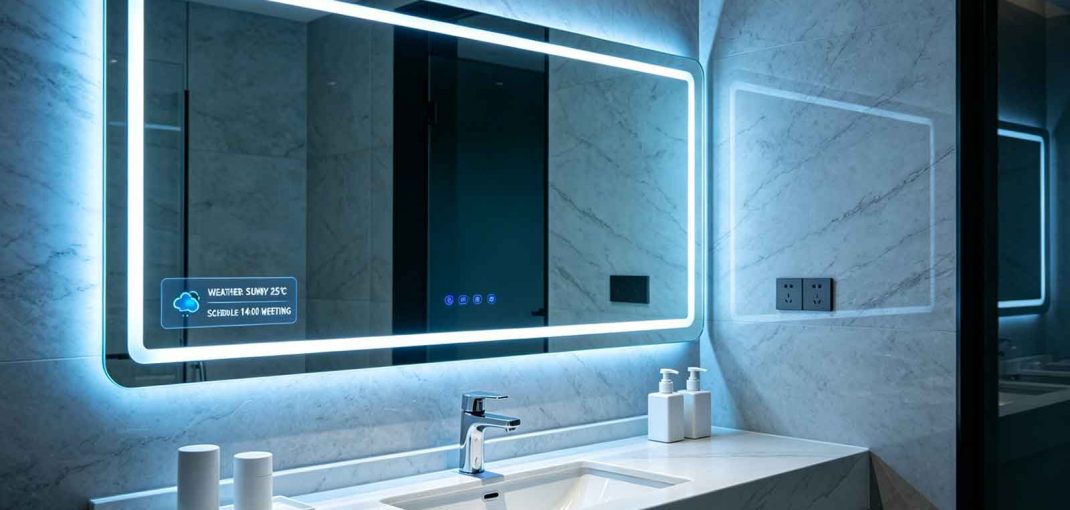
The concept of Mirror as a Screen is gaining traction. When off, it remains a clean, high-end silver mirror; when activated, the ultra-thin embedded screen shows real-time weather, traffic, stock updates, or reminders. In hotel procurement, these mirrors act as “virtual concierges,” enabling guests to book services or check events directly on the mirror.
In-depth Customization for Vertical Industries: Building a Competitive Edge
The B2B market is becoming more fragmented, requiring suppliers to deeply understand specific scenarios. Three high-growth vertical segments stand out today:
1. Hospitality & Lodging: Focus on Durability and Brand Consistency
For major chains like Hilton and Marriott, search trends emphasize easy maintenance und brand consistency.
- Hotels often prefer anti-glare backlit designs to create a premium atmosphere.
- Modular designs that make drivers and light strips easy to replace help reduce long-term operating costs.
2. Healthcare & Wellness: AI as an Entry Point
This segment is growing rapidly. Searches for AI Skin Analysis Mirror have increased significantly in B2B queries.
- Medical aesthetics clinics and high-end wellness centers look for smart mirrors with high-CRI (>95) lighting and magnifying cameras to analyze skin moisture, fine lines, and UV damage.
- Telemedicine-ready mirrors with one-click doctor connections are entering premium senior living communities.
3. Retail & Fitness: The Power of AR
In flagship stores like Nike and Lululemon, LED mirrors serve as “fitting assistants.” Interactive models with AR fitting, 360° video playback, and social media sharing help retailers improve offline conversion rates.
Key Vertical Segments & Core Demands
|
Industry
|
Core Needs
|
Typical Applications
|
|---|---|---|
|
Gastfreundschaft
|
Easy maintenance, brand consistency, anti-glare backlight, modular repairability
|
Hilton, Marriott, high-end resorts
|
|
Healthcare & Wellness
|
AI skin analysis, CRI >95, telemedicine connectivity
|
Clinics, beauty centers, senior communities
|
|
Retail & Fitness
|
AR fitting, 360° replay, social sharing
|
Brand flagship stores, gyms
|

Sustainability: The “Green Pass” to Enter European and American Markets
After 2024, environmental protection is no longer a slogan but a tangible trade barrier. In B2B procurement contracts in Europe (especially Germany, France, and Nordic countries), environmental clauses account for an increasing proportion year by year.
1. Lead-free & Copper-free Mirror Technology
2. Energy Efficiency and Life Cycle
Global Supply Chain and Market Distribution
1. Demand Side: North America Leads, Asia-Pacific Surges
- North American market: Still the world’s largest consumer market, with strong and sustained demand for smart mirrors in residential renovation projects, especially favoring oversized, minimalist frameless designs.
- Middle Eastern market: Driven by mega-projects such as Saudi Arabia’s NEOM, demand for luxurious, highly customized smart mirrors is growing exponentially.
-
Buyers should prioritize suppliers with localized support to shorten lead times.
2. Supply Side: China’s Manufacturing Shift from “Quantity” to “Quality”

B2B Buyer Search Keyword Trend Map
- Core functions: Anti-fog Bluetooth LED Mirror, Adjustable Color Temperature Mirror
- Professional scenarios: Contract Grade Bathroom Mirrors, ADA Compliant Lighted Mirrors
- Forward-looking technology: Smart Mirror with Android OS, Voice-activated Vanity Mirror
Conclusion: The Key Word for Future Success is “Boundary”
Häufig gestellte Fragen (FAQ)
A: The combination of smart integration (especially Matter protocol) and sustainable materials. Basic illuminated mirrors are no longer enough for high-end buyers — IoT-enabled customized products are becoming the mainstream.
A: Look for contract-grade standards: copper-free mirror surface, high-CRI LED, long L70 lifespan, anti-fog heating, and reliable supply chain support. Always request samples for real-world testing.
A: The unit price may be 10–25% higher initially, but reduced maintenance frequency and improved guest experience often lead to payback within 1–2 years. Many hotel projects now treat them as value-adding features.
A: Yes. We support full customization from dimensions and lighting to smart modules. Feel free to share your project drawings — we can provide quick quotes and samples.
Referenzen
- Mordor Intelligence. (2026). Smart Mirror Market – Size, Share & Forecast. Retrieved from https://www.mordorintelligence.com/industry-reports/smart-mirror-market
(Cited for global smart mirror market size of USD 4.92 billion in 2026, growing at a CAGR of 8.42% to USD 7.37 billion by 2031.) - Fortune Business Insights. (2026). Smart Mirror Market Size, Share & Industry Analysis. Retrieved from https://www.fortunebusinessinsights.com/smart-mirror-market-104616
(Cited for additional market growth insights and North America’s leading position in the smart mirror sector.)
Frank Chan ist Senior Product Consultant & Sales Manager bei Dimo und verfügt über mehr als 10 Jahre Erfahrung im Bereich der High-End-LED-Beleuchtung. Er hat die Einhaltung der Vorschriften und die Installation von über 200 Projekten in ganz Nordamerika beaufsichtigt. Frank Chan unterstützt B2B-Kunden bei der Einhaltung komplexer elektrischer Vorschriften, um einen langfristigen Projekterfolg zu gewährleisten.