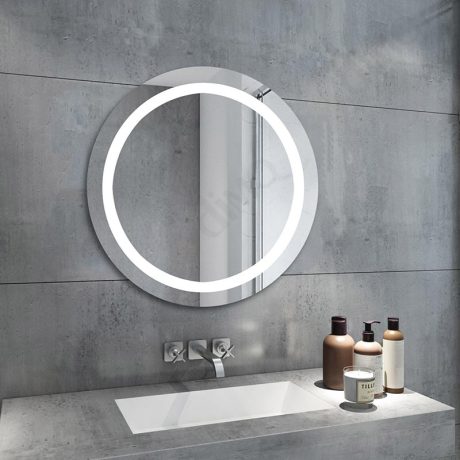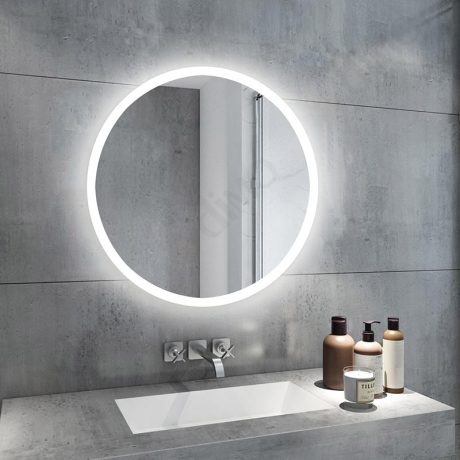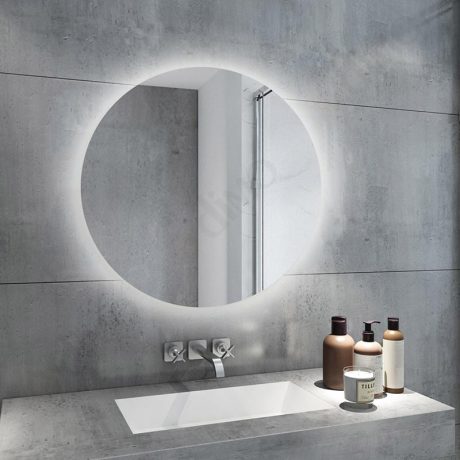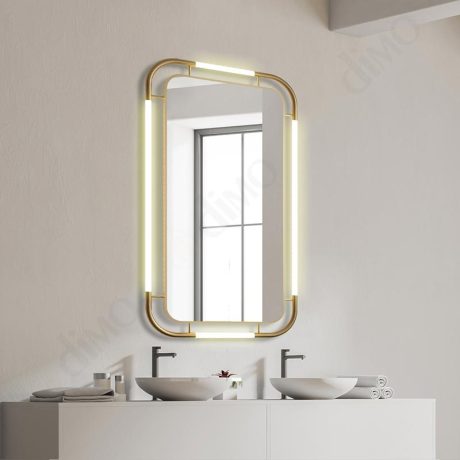
Miroir LED de salle de bain Fabricant Fournisseur en gros

Global LED Bathroom Mirror Trends 2026–2031: Technical & Compliant

Global Smart Bathroom Transformation Drives Strategic Surge in LED Bathroom Mirrors

[New York, May 15, 2026] Fueled by strong demand in high-end residential renovations and the deep integration of smart living ecosystems, the North American and European smart bathroom markets are undergoing profound supply chain restructuring. According to leading building industry associations and market research firms, the global market for smart lighting-enabled bathroom fixtures is projected to grow at a 11.2% CAGR from 2026 to 2031.

Against this backdrop of hardware upgrading, LED bathroom mirrors have emerged as a core smart bathroom endpoint, with accelerating market penetration. From custom five-star hotel projects to modular high-end residential installations, global buyers now impose rigorous standards for product safety, optical performance, and end-to-end supply chain fulfillment.

DIMO, a leading smart optoelectronics manufacturer and trusted LED mirror supplier serving the North American market, has partnered with industry research institutions to release the Global LED Bathroom Mirror Trends 2026–2031 : Technical Compliant White Paper. This report provides the first comprehensive analysis of critical challenges cross-border B2B buyers will face over the next five years, including evolving building codes, user experience upgrades, and geopolitical supply chain volatility.

Table des matières

North American Building Code Updates: Full-Unit Certification as the Mandatory Standard

 
Historically, many B2B contractors and wholesalers operated under a common compliance misconception: that UL or ETL certification on internal power components alone would satisfy inspection requirements. However, enforcement of North American National Electrical Code (NEC) standards for wet-location electrical devices has tightened sharply, and partial-component compliance now frequently results in failed site inspections.
 

End of Partial Compliance: Full-Unit Testing Becomes Mandatory

 
Electrical inspectors now enforce UL 962 as the primary standard, requiring LED bathroom mirrors to be tested and certified as complete, standalone electrical appliances. Full-unit testing includes temperature rise, earth leakage protection, and high-voltage dielectric breakdown testing.
 
As a leading LED bathroom mirror manufacturer with 15 years of North American market expertise, a DIMO technical lead emphasized: “The bathroom is an environment where skin resistance is at its lowest. Partial certification leaves risks of micro-leakage from LED strips, touch controls, and defoggers under long-term moisture exposure. Full-Unit UL/ETL Listed certification is the only reliable safeguard to ensure project acceptance and mitigate legal liability for developers.”
 

Shift in B2B Procurement Risk Exposure

 
Hotel developments with 100+ rooms face catastrophic costs from project delays and rework if non-compliant mirrors delay occupancy permits. As a result, suppliers with full-unit certified manufacturing capabilities are rapidly gaining share at the expense of low-cost, non-compliant assembly facilities.

From Basic Illumination to Color Accuracy: CRI 90+ & Medical-Grade Optical Integration

 
Beyond safety compliance, end-user expectations for bathroom lighting have evolved significantly. Budget-focused projects historically used low-cost LED strips with a Color Rendering Index (CRI) of 70–80, resulting in unnatural, cool-toned lighting that distorts skin tone and creates visual discomfort.
 

CRI Performance Directly Impacts Guest Satisfaction

 
Research from the Société d'ingénierie de l'éclairage (IES) confirms that bathroom mirrors support precision visual tasks including makeup application, grooming, and personal care. A high CRI rating of 90+ with R9 > 50 delivers accurate reproduction of natural skin tones and true cosmetic colors. Low CRI lighting is a leading cause of guest complaints in high-end hospitality, as makeup applied under poor lighting appears mismatched in natural daylight.
 
Leading LED bathroom mirror manufacturers now integrate medical-grade optical matrices into commercial and residential bathroom applications.
 

MacAdam Ellipse Control for Uniform Color Temperature

 
For large-scale hotel projects, inconsistent color temperature across mirror units undermines aesthetic quality and perceived value. Professional LED mirror suppliers implement strict MacAdam Ellipse color tolerance controls at the component level to ensure consistent light output across production batches, preserving premium design integrity.
high-quality-led-light-cct-cri-strip-mirror light strip

Market Metrics Comparison: Project-Grade vs. Retail-Grade LED Bathroom Mirrors (2026–2031)

 
The table below summarizes key technical and compliance benchmarks for B2B project-grade mirrors versus standard retail-grade products, based on recent supply chain industry research.
 
Evaluation Category Project-Grade Standard (B2B) Traditional Retail / Low-Cost Standard
Certification Full-Unit UL/ETL Listed Component-only certification
Glass Substrate 5mm Copper-Free Eco Silver Mirror (anti-oxidation, edge blackening resistance) Standard Aluminum Mirror / Economy Silver Mirror (prone to oxidation)
Optical Performance (CRI) CRI 90+ / High R9 (true color rendering) CRI 70–80 (distorted skin tone, eye fatigue)
Defogger Safety PET Thermostatic Film with Over-Temperature Fuse Basic Resistance Wire (uneven heating, fire risk)
Ingress Protection IP44 Standard; IP65 Optional Basic Fiberboard Back Seal (no moisture protection)
Fulfillment & Logistics Breakage Rate <0.5% + 1–2% Buffer Stock High Breakage Rate; No Replacement Commitment
 
Market advantages over the next five years will strongly favor manufacturers committed to engineering quality, electrical safety, and supply chain reliability.
 

Smart Interaction Evolution: PET Defogging & Modular IoT Architecture

 
Next-generation LED bathroom mirrors are evolving from passive lighting fixtures into integrated smart home and guestroom control hubs.
 

PET Adaptive Defogging & Energy Efficiency

 
Traditional defoggers rely on high-consumption resistance wires with uneven heating and long-term insulation degradation risks. Updated safety standards now mandate PET thermostatic heating films that adjust power dynamically to maintain a stable 10–15°C above ambient temperature, with integrated auto-shutoff timers. This design reduces energy use and eliminates fire hazards from overheating.
 

Modular Smart Systems Reduce After-Sales Costs


Contractors historically avoided high-feature mirrors (Bluetooth, displays, weather) due to costly, unit-level replacement for component failures. Leading global LED mirror suppliers have resolved this with modular electrical architecture, separating touch controls, drivers, defoggers, and smart modules into independently serviceable units.


Field technicians can replace faulty modules in minutes without mirror removal, drastically lowering commercial maintenance costs.


Industry Expert Insights: Evaluating True Landed Cost for Cross-Border Projects

 
“We evaluate suppliers not on sample quality, but on breakage rates and on-time delivery for 1,000+ unit orders,” noted a senior partner at a global engineering procurement consultancy.
 
For large, fragile mirror products, ocean freight and last-mile logistics represent the highest operational risk.
 

Engineered Packaging for Breakage Prevention

 
Top manufacturers including DIMO apply engineering-grade packaging design: 5-layer honeycomb cardboard, high-density EPE corner guards, and fumigation-free plywood pallets. This system consistently maintains cross-border breakage rates below 0.5%.
 

Strategic Buffer Stock

 
On-site breakage during installation is common. Experienced LED mirror suppliers include a 1% buffer stock as standard, reducing project downtime and labor costs for developers.

Conclusion & Strategic Outlook (2026–2031)

 
The 2026–2031 period will mark a major industry consolidation for the global LED bathroom mirror market. Low-cost, non-compliant assembly operations will be displaced by stricter regulation and professional buyer requirements. Manufacturers prioritizing safety, high-fidelity optics, and modular engineering will capture sustained growth in high-end hospitality and smart residential segments.
 
For B2B buyers, partnering with a Full-Unit certified supplier with strong value engineering capabilities is both a compliance risk mitigator and a driver of long-term building asset value.


Recommended Reading & Authoritative Resources


Internal Links


External Authoritative References

 
Laisser un commentaire

Votre adresse e-mail ne sera pas publiée. Les champs obligatoires sont indiqués avec *