Bathroom LED Mirror Manufacturer Wholesale Supplier

led-mirror-packaging

The Science of LED Mirror Packaging for Safe Shipping

Imagine a customer unboxing a premium, $200 backlit LED vanity mirror they’ve eagerly anticipated for weeks. They open the box, only to find shards of shattered glass and a bent aluminum frame. To make matters worse, loose electronic components are rattling around inside. For any B2B brand, e-commerce reseller, or hospitality procurement manager, this scene is a financial and operational nightmare. Returns skyrocket, profit margins evaporate, and your brand reputation takes a massive hit.

Shipping fragile glass is hard enough on its own. However, when you integrate delicate touch sensors, anti-fog heating pads, and fragile LED drivers, the stakes multiply. Standard bubble wrap and a thin cardboard box simply won’t cut it anymore.

Over the years, our team at DIMO has designed supply chain solutions for commercial vanity brands. We’ve learned that achieving a near-zero damage rate requires blending protective structural engineering with strict logistics cost management. Let’s look at what it actually takes to protect these high-value products during transit.

Table of Contents

Why Standard Packaging Fails LED Mirrors

Many factories still treat smart mirrors like regular bathroom mirrors. They wrap the edges in cardboard, throw in some styrofoam chips, and hope for the best. This approach completely ignores the complex anatomy of modern smart tech.
dimo-led-mirror-packaging-design
A standard mirror only needs surface and edge scratch protection. An LED mirror, on the other hand, faces distinct vulnerabilities that demand custom-engineered solutions.
Protection Factor Standard Glass Mirrors Smart LED Mirrors
Primary Risk Surface scratching and direct impact cracks. High-frequency transit vibration cracking solder joints.
Weight Distribution Uniform, relatively lightweight. Top-heavy glass bonded to a dense, localized aluminum chassis.
Corner Vulnerability Low to moderate chip risk. High risk; aluminum frame flex creates extreme pressure points.
Internal Hazards None. Loose power cords or shifting transformers shattering glass from the inside.
Moisture Risk Low. High; condensation can ruin internal anti-fog circuit boards.
When a delivery truck hits a pothole, high-frequency vibrations travel through the box. If the internal components aren’t properly secured, those vibrations can crack the delicate solder joints in the LED drivers or snap the connections to the touch sensors. This leaves you with a mirror that arrives intact but completely fails to turn on.

Our Experience: The $80,000 Logistics Pivot

We learned this lesson firsthand a few years ago. A luxury hospitality client approached DIMO to supply 3,400 smart backlit mirrors for a premium hotel remodel. Our initial factory partner used standard 15mm white expanded polystyrene (EPS) foam blocks inside a 3-ply carton. It seemed sturdy during a simple warehouse lift test.
The reality of the road was much harsher. The first batch of 200 units arrived at the hotel site via Less-Than-Truckload (LTL) shipping, and 24 of them were completely shattered. That represented a brutal 12% breakage rate. Even worse, the EPS foam had crumbled into thousands of static-charged white beads during transit. The hotel staff spent hours cleaning up the mess, creating a terrible unboxing experience.
mirror broken (2)
We immediately halted production. Our engineering team redesigned the entire layout, swapping the brittle EPS foam for custom-molded Expanded Polyethylene (EPE). We engineered precise cavities into the back foam to isolate the heavy power transformers. This prevented them from shifting and exerting pressure on the glass surface.
We put the new prototype through rigorous physical testing. It passed with flying colors. The remaining 1,200 mirrors were delivered with only three minor damages, bringing our breakage rate below 0.3%. This quick pivot saved the project’s timeline and protected our client’s bottom line.

The 5-Layer Engineered Blueprint

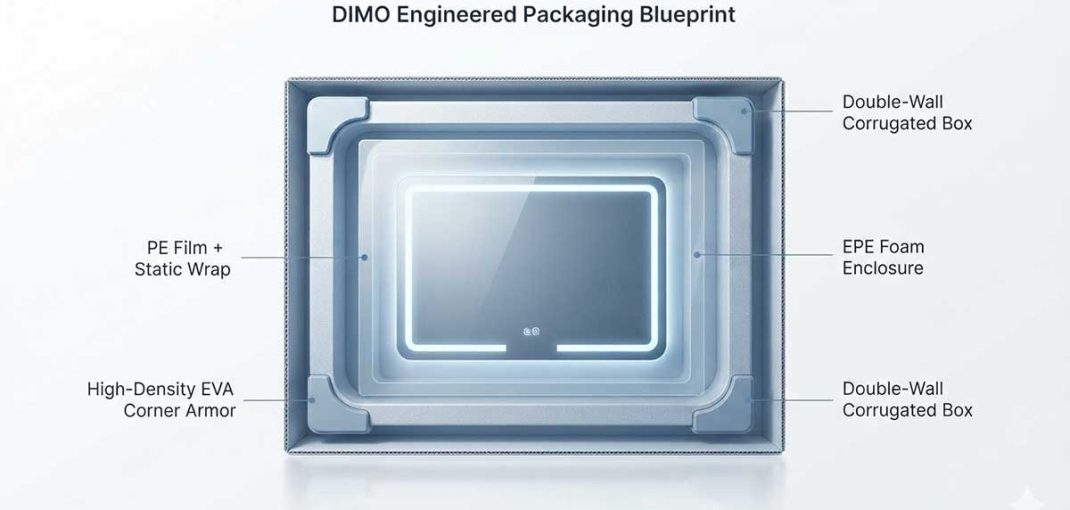
Through years of trial, error, and testing, we developed a 5-layer system that keeps fragile cargo safe through any transit environment.

Layer 1: Surface Defense and Static Shielding

First, we apply a low-tack, anti-scratch PE protective film directly across the entire glass front. We then wrap the unit in static-shielding bags to protect the touch-sensitive control areas from electrostatic discharge during dry winter transit.

Layer 2: High-Density EVA Corner Armor

Corners absorb over 70% of all impacts during a accidental drop. Instead of using flimsy cardboard guards, we clamp custom-shaped, high-density Ethyl Vinyl Acetate (EVA) foam blocks onto all four corners. EVA is highly resilient and deflects sharp kinetic energy away from the vulnerable edges of the glass.

Layer 3: Shock Absorption Cavity

We encase the mirror in a form-fitted EPE foam enclosure that is at least 20mm thick. Unlike cheap styrofoam, EPE is flexible, bounces back after impacts, and doesn’t flake into messy white crumbs. We cut custom cavities into the rear of the foam block to hold the power cords and hardware kits safely away from the glass.

Layer 4: Structural Outer Shell

The exterior box needs to withstand significant stacking pressure. We use 5-layer, double-wall corrugated shipping boxes rated at ECT-44 (Edge Crush Test) or a minimum of 300# burst test grade. These boxes can survive heavy shifting inside overseas containers or local delivery vans without buckling.

Layer 5: Palletization and Unitized Bundling

For large B2B wholesale orders, individual cartons should never travel loose. We secure the cartons onto IPPC-certified wooden pallets, wrap them tightly in heavy-duty stretch film, and reinforce them with vertical honeycomb corner boards. This turns individual boxes into a single, stable unit that forklift drivers can move safely.

 
dimo-led-mirror-packaging-design-compare

The Science Behind Safe Transit

We never guess whether a packaging design will keep your products safe. Instead, we rely on clear, objective laboratory verification. If you want to sell products on major e-commerce platforms or ship high-value items via courier networks, your packaging should pass official ISTA (International Safe Transit Association) testing protocols.
dimo-led-mirror-packaging-drop-testing
The gold standard for small parcel delivery networks like UPS or FedEx is the ISTA-3A test. This rigorous simulation subjects a single packaged product to a sequence of harsh real-world conditions:
  • Atmospheric Conditioning: High humidity and temperature testing to ensure the carton’s structural glue won’t fail in tropical transit.
  • Shock/Drop Testing: A precise series of 10 drops from heights up to 30 inches, targeting the most vulnerable corners, flat faces, and longest edges.
  • Random Vibration: Placing the box on a shake table with weighted plates on top to mimic the rough ride of a bumpy delivery truck bed.
When we design custom boxes, we put them through these physical drop sequences. If a structural foam wall buckles or an internal component shifts during testing, we refine the design before mass production begins. For large-scale project distribution or full-container shipments, we reference ASTM D5118 packaging design criteria to make sure our corrugated specs can withstand heavy industrial stacking.

Balancing Safety with Shipping Costs

It’s easy to make a product completely unbreakable if you don’t care about the size or cost of the box. You could wrap a mirror in six inches of foam, but the resulting oversized freight charges would quickly eat up your profits.
Most global logistics networks charge based on Dimensional (DIM) Weight rather than actual physical weight. They use a standard formula to penalize bulky, poorly designed packages:
 

If your box contains unnecessary “dead air” space, you are paying to ship empty volume. Our engineering team focuses on optimizing this space. By using high-density, custom-molded inserts, we can often reduce total package volume by 15% to 25% while maintaining excellent shock protection.

dimo-led-mirror-packaging-drop-testing-and-weight
This careful optimization directly improves your bottom line, especially for cross-border e-commerce brands utilizing sea freight consolidation or air express networks.

Creating an Unboxing Experience

B2B packaging should protect your products, but it shouldn’t look like an industrial block of ugly plastic. Enterprise buyers and retail consumers alike appreciate clean, intentional design when opening a package.
Modern brands are moving away from traditional petrochemical foams that clog up consumer trash bins. We use 100% recyclable corrugated cardboard structures and low-density EPE foam parts that are easy to compress and recycle.
We also design our inserts with helpful thumb notches and clear pull tabs. This allows your customers to lift heavy, fragile mirrors safely out of their boxes without having to wrestle with tight packaging or use sharp box cutters near the glass surface.
[Secure Packaging Design] --> [Easy-Open Thumb Notches] --> [Happy Enterprise Customer]
Investing in custom-engineered packaging does more than just cut down your damage rates. It protects your hard-earned margins, improves your brand’s unboxing experience, and gives you a real competitive edge in the smart home and hospitality markets.

People Also Ask (FAQ)

What is the best packaging material to protect an LED mirror during international shipping?
Molded, high-density Expanded Polyethylene (EPE) foam is the most effective choice for international transit. Unlike standard white styrofoam (EPS), resilient EPE cushions heavy items without flaking or cracking under repeated road vibrations. Pair it with an outer 5-ply double-wall box rated for at least ECT-44 structural strength.
How do I prevent internal electronic components from breaking inside the mirror package?
Make sure your factory cuts dedicated, form-fitted slots into the back foam insert to hold power cords, driver boxes, and mounting hardware securely in place. This prevents loose, heavy components from shifting during transit and cracking the fragile glass panel from the inside out.
What specific testing standards should my LED mirror packaging pass?
For direct-to-consumer parcel shipping through networks like FedEx, DHL, or UPS, your packaging should pass the ISTA-3A drop and vibration test protocol. For bulk wholesale freight or palletized container distribution, look for compliance with ISTA-1A or standard ASTM D5118 structural packaging guidelines.

References & Industry Standards


If you are dealing with high damage rates or want to optimize your current shipping dimensions to reduce freight costs, we can help. Get in touch with our packaging engineers today for a custom diagnostic evaluation of your product line.
ABOUT AUTHOR
Frank Chan is the Senior Product Consultant & Sales Manager at Dimo, with over 10 years of experience in high-end LED lighting. He has overseen the compliance and installation of over 200 projects across North America. Frank is dedicated to helping B2B buyers navigate complex electrical codes to ensure long-term project success.

Leave a Reply

Your email address will not be published. Required fields are marked *