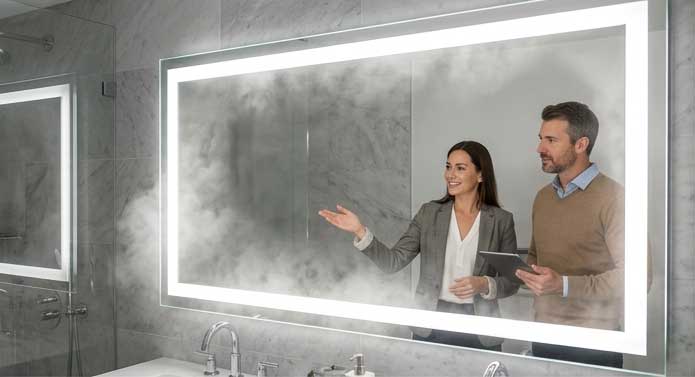
Have you ever noticed how a five-star hotel guest’s morning routine can be ruined by something as simple as steam? Imagine a guest stepping out of a luxurious rain shower, only to find the centerpiece of the bathroom—the vanity mirror—completely obscured by a thick, stubborn fog. They reach for a towel, wipe the glass, and leave behind unsightly streaks that remain for the rest of the day.
In the world of B2B hospitality and high-end residential development, this isn’t just a minor annoyance. It is a failure of functional design. As a long-standing partner in the LED mirror manufacturing industry, we’ve seen how the shift from traditional glass to the integrated anti-fog mirror has redefined guest expectations.
But for a project manager or a wholesaler, the question isn’t just “Should we buy them?” It’s “Which engineering choice will save us from maintenance nightmares five years down the line?”
Table of Contents
The Engineering Reality: It’s Not Just a Mirror, It’s a System
Why “Copper-Free” is the B2B Gold Standard
The Crucial Comparison: Standard vs. Integrated LED Anti-Fog Mirrors
| Feature | Traditional Mirror + Sconce | Professional Anti-Fog LED Mirror |
|---|---|---|
| Visibility | Fogs up instantly; requires manual wiping. | Remains crystal clear via integrated heating pad. |
| Light Quality | Often creates shadows on the face. | CRI 90+ front-lit/back-lit for flawless task lighting. |
| Corrosion Resistance | High risk of “Black Edge” within 2-3 years. | Copper-free silver glass; 10+ years oxidation-free. |
| Maintenance | Frequent cleaning of streaks/residue. | Minimal cleaning; self-drying surface. |
| Installation | Requires separate electrical for lights/outlets. | Single power point; integrated electronics. |
| Industry Standards | Basic Safety | UL 962 & IP44 Waterproof. |

A Real-World Lesson: The “Half-Clear” Disaster
How We Build It: A Peek Inside the Factory Floor
- Glass Pre-treatment: We start with 5mm high-definition, copper-free silver glass. Every edge is polished to prevent micro-cracks.
- The Heating Pad Application: We apply the PET heating film using a pressure-sensitive adhesive. It must be perfectly flat. Any air bubble becomes a “cold spot” where fog will collect.
- LED Integration: We install high-density 120 LEDs/meter strips. We favor a 3000K-6000K switchable CCT (Correlated Color Temperature) to allow guests to choose between warm ambient light and cool “makeup” light.
- Sealing and Safety: This is the critical step. We seal the electronics inside an ABS or aluminum back-box. We then test the unit for IP44 compliance, ensuring that splashing water from a sink or shower cannot penetrate the electrical housing.
- The 4-Hour Burn-In: Every anti-fog mirror stays powered on for 4 hours in our QC bay. We use infrared thermal cameras to verify that the heat distribution is even across the glass surface.

Installation: The “Hidden” Success Factor
People Also Ask (FAQ)
No. While it can be wired to stay on, we recommend connecting it to the bathroom light switch or using an integrated touch sensor with an auto-off timer (usually 60 minutes) to conserve energy and prolong the life of the heating pad.
Yes. In our designs, the LED driver (transformer) and the heating pad are modular. If a component fails after the warranty period, a hotel engineer can replace the driver in about 15 minutes without removing the glass from the wall.
Absolutely. As long as the mirror is IP44 or IP65 rated, it is designed to handle “zone 2” bathroom environments. This means it is protected against water splashes from any direction.
A professional-grade anti-fog mirror typically starts clearing within 30 seconds of activation and reaches full clarity within 2-3 minutes, depending on the ambient temperature.

References & Industry Standards
- UL 962 Standard for Safety: The premier standard for household and commercial furnishings (including lighted mirrors) in North America. Link to UL Standard.
- IEC 60529 (IP Ratings): International standard defining the degrees of protection provided by enclosures against water and dust. Link to IEC.
- ISO 9001:2015: Quality management systems ensuring consistent product quality in manufacturing. Link to ISO.
Final Thoughts
Frank Chan is the Senior Product Consultant & Sales Manager at Dimo, with over 10 years of experience in high-end LED lighting. He has overseen the compliance and installation of over 200 projects across North America. Frank is dedicated to helping B2B buyers navigate complex electrical codes to ensure long-term project success.